

TED vs. PRP vs. Microneedling: Which Non-Surgical Hair Restoration Treatment Is Right for You?
If you've started researching non-surgical hair restoration, you've probably run into three terms over and over: TED, PRP, and microneedling. They all aim to do the same general thing — stimulate the follicle and encourage hair growth without surgery — but they work in meaningfully different ways. Here's a clear breakdown of each, so you can understand what you're actually choosing between.
TED Hair Restoration
What it is: TED (Trans-Epidermal Delivery) uses ultrasound technology to push growth factors and peptides through the skin barrier and directly to the hair follicle — no needles, no punctures.
How it works: Acoustic energy temporarily opens up the pathway through the skin, allowing topical growth factors to reach a depth they otherwise couldn't penetrate to on their own. The follicle receives the nutrients it needs to support stronger, denser regrowth.
Best for: People who want a non-invasive option with no needles, no downtime, and zero pain. This is one of the biggest practical differences between TED and the other two options below — TED is completely pain-free, with nothing to numb and nothing to recover from. It's also a strong option for people with sensitive scalps or scarring/inflammatory conditions where needling could aggravate the area.
What to expect: Sessions typically take 30–60 minutes, with a series of 3–6 sessions recommended depending on your goals. No downtime — you can go straight back to your day.
PRP (Platelet-Rich Plasma)
What it is: PRP involves drawing a small amount of your own blood, spinning it in a centrifuge to concentrate the platelets and growth factors, and then injecting that concentrate into the scalp.
How it works: Platelets are rich in growth factors that signal follicles to enter (or stay in) the growth phase. Because it uses your own blood, there's no risk of an allergic reaction to the substance itself.
Best for: People comfortable with needles who want a treatment using their own biological material, often for androgenetic alopecia (pattern thinning).
Worth knowing: Because PRP uses growth factors from your own blood, you're working with whatever growth factor levels and quality your body is currently producing — which naturally decline with age and aren't as concentrated or potent as the biologic growth factors and peptides used in treatments like TED, which deliver them at a higher, more consistent concentration than your own blood typically provides.
What to expect: Involves a blood draw and injections directly into the scalp — generally more invasive than TED, with real discomfort during the injections. Many providers numb the scalp beforehand to make the injections tolerable, and some redness or soreness afterward is common. Often requires a series of sessions, followed by maintenance treatments.
Microneedling
What it is: A device with fine needles creates controlled micro-injuries in the scalp, which triggers the body's wound-healing response and can also be used to help topical treatments absorb more deeply.
How it works: The micro-injury triggers a localized healing/inflammatory response that can stimulate blood flow and follicle activity. It's also frequently combined with topical growth factors or PRP to enhance absorption.
Best for: People looking for a lower-cost entry point, often paired with other topical treatments rather than used completely on its own.
What to expect: Real discomfort — many providers apply a numbing cream beforehand to make the treatment tolerable, since the needles (even at micro-depth) can sting, especially over multiple passes. Some redness afterward is common. Often used as a complementary treatment alongside other protocols rather than as a standalone solution for significant hair loss.
How They Compare
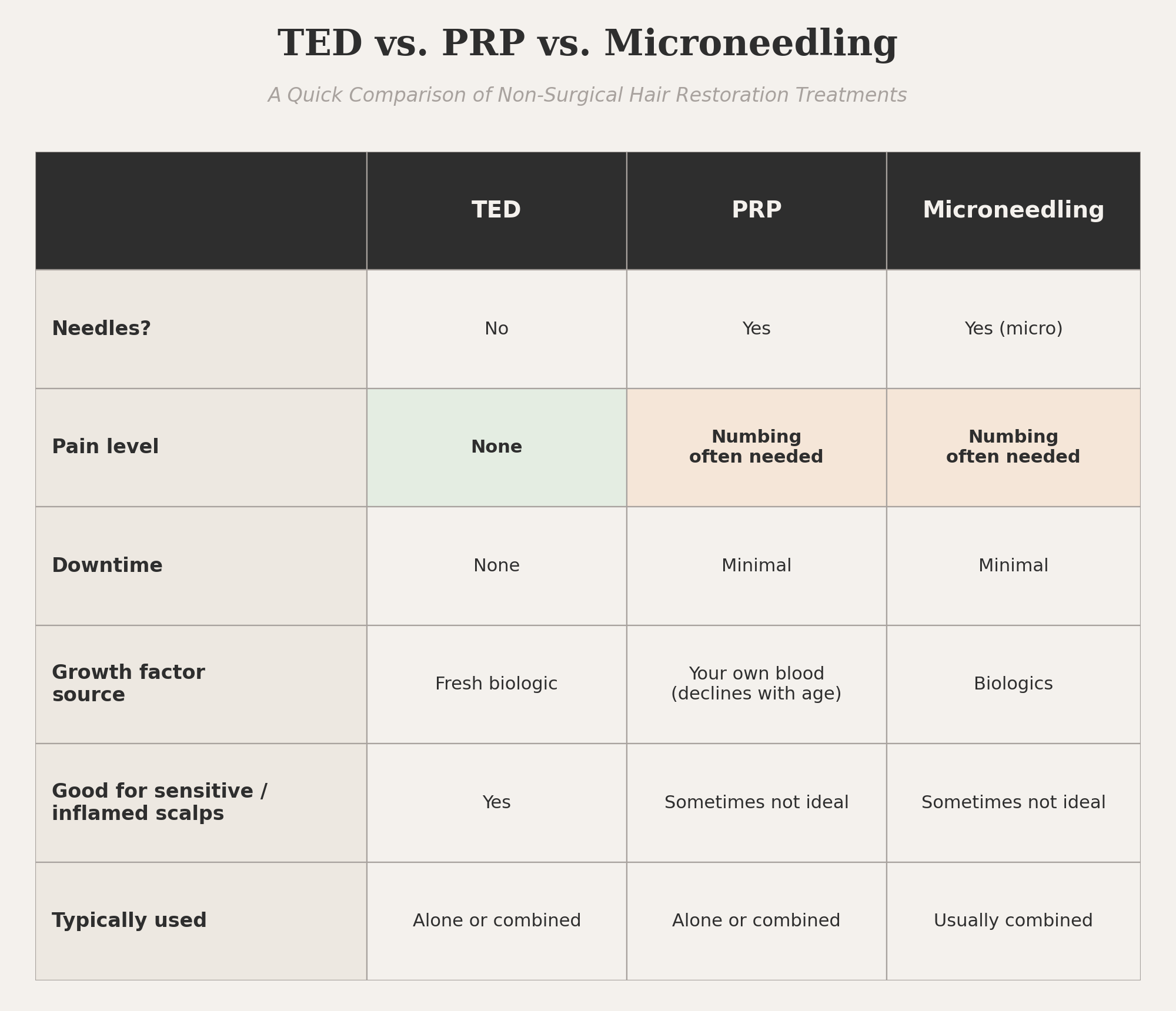
So Which One Is Right for You?
There's no universal "best" — it depends on your specific type of hair loss, your scalp condition, your comfort with needles, and your goals. Someone with scarring alopecia or active scalp inflammation is generally a better candidate for a non-invasive option like TED, while someone with stable pattern thinning and no needle aversion might be a great PRP candidate.
This is exactly why a proper scalp evaluation matters before choosing a treatment — what works beautifully for one person's hair loss pattern may not be the right fit for another's.
Not sure which treatment fits your situation? Book a Hair + Scalp Evaluation at Copper Hair Co. in Meridian, ID, and we'll build a plan around what your scalp actually needs.